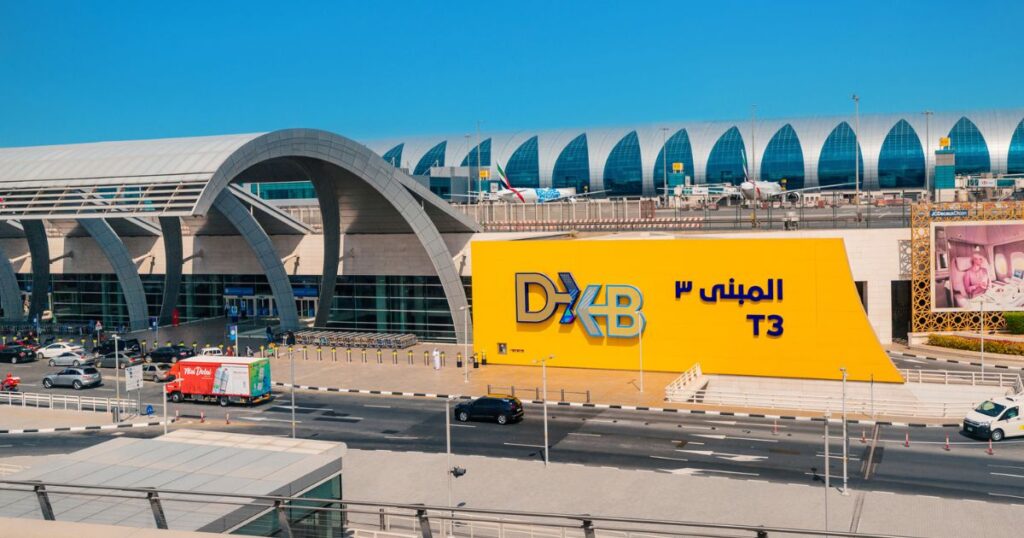
DUBAI: Every commercial aviation service operating out of Dubai International Airport (DXB) will officially shift to Al Maktoum International Airport in 2032. The historic migration will permanently close the world’s busiest international transit hub as it breaches its absolute maximum structural capacity.
Dubai Airports Chief Executive Paul Griffiths confirmed the unprecedented aviation transfer, noting that maintaining two massive transport hubs operating concurrently within 70 kilometres of one another is neither economically nor logistically viable. The transition will require all international carriers, logistics operators, and retail tenants to vacate the legacy northern site entirely.
Table of Contents
DXB Passenger Capacity Reaches Maximum Ceiling by 2031
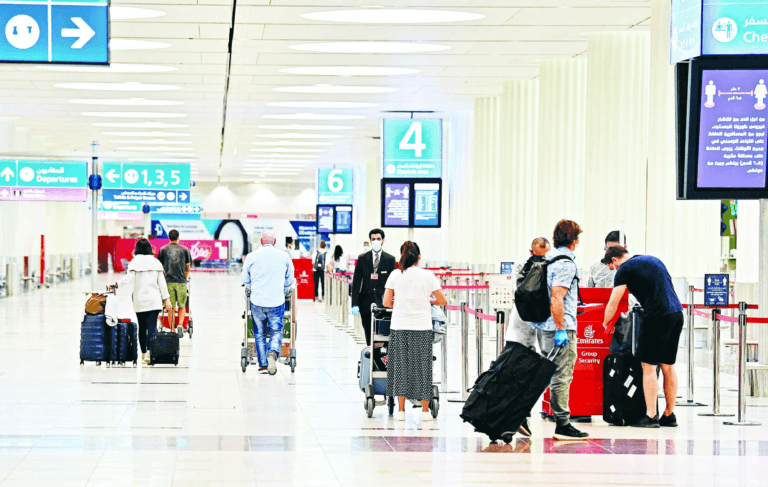
Current federal projections indicate DXB will cross the 100 million annual passenger threshold within two years. By 2031, aviation authorities expect that number to swell to 114 million travellers. Because the existing facility sits completely landlocked by dense residential and commercial real estate near the Sharjah border, expanding the structural footprint or adding new runways remains physically impossible.
“The current thinking is that when DXB gets to a point where we’ve got enough capacity created at DWC to make the complete transition, that we will move every single service,” Griffiths stated during recent industry briefings. He noted that by 2032, the vast majority of physical assets at Dubai International Airport will reach the end of their operational lifespans. Reinvesting heavy capital into a site with zero growth potential is viewed as economically unfeasible.
AED 128 Billion Al Maktoum International Airport Expansion Commences
The AED 128 billion aviation megaproject will pull the emirate’s entire flight network south to the Dubai World Central (DWC) site. Upon final completion, the newly expanded Al Maktoum facility will encompass an area roughly five times larger than DXB.
The initial 2032 phase targets a designated capacity of 150 million annual passengers. The fully realised masterplan, stretching toward a 2057 completion date, will eventually accommodate up to 260 million passengers navigating through 400 aircraft gates and five parallel runways. Transport infrastructure upgrades include a direct link to the forthcoming Etihad Rail network, allowing passengers to utilise early baggage drop systems at remote regional train stations before commuting directly to the southern departure terminals.



Emirates Airline Prepares Unified Dubai South Relocation Strategy
Rather than staggering the migration over a decade, Emirates Airline plans to transfer its entire global operational network in a single, unified push. To facilitate this massive logistical undertaking, the carrier’s chairman, Sheikh Ahmed bin Saeed Al Maktoum, authorised immediate heavy infrastructure development within the surrounding Dubai South district.
Emirates is actively constructing a dedicated aviation engineering complex slated for completion by 2030. Simultaneously, a multi-billion-dirham residential village is under construction to permanently house 12,000 cabin crew members near the new runways. Budget carrier flydubai, alongside dozens of foreign operators such as British Airways and Air India, will execute identical forced relocations to secure their future UAE landing slots.
Urban Redevelopment Triggered by Dubai International Airport Closure
Decommissioning the current DXB site unlocks millions of square metres of prime real estate directly in the city’s traditional centre. Urban planners expect the geographic pivot to fundamentally alter Dubai’s demographic trajectory, drawing commercial headquarters and residential populations away from the highly congested northern borders.
Officials anticipate the southward migration will ease severe traffic bottlenecks currently plaguing routes between Dubai and Sharjah. While the primary operational shift remains locked for 2032, aviation authorities are already incentivising regional and cargo airlines to claim available landing slots at the southern facility to mitigate the immediate, mounting overflow at DXB.