The UAE job market in 2026 is neither uniformly weak nor experiencing an across-the-board boom. The more accurate picture is a selective and skills-driven market: hiring has shown signs of recovery, but employers are increasingly prioritising specialised capabilities, digital skills, regulatory knowledge and measurable business impact.
For job seekers in Dubai and the wider UAE, this means that sending large numbers of generic applications is becoming less effective. The stronger strategy is to target resilient sectors, tailor applications carefully, build demonstrable skills and understand how Emiratisation, technology and sector-specific regulation are influencing recruitment.
Table of Contents
The UAE job market is showing resilience
The UAE Economic Graph Report 2026, prepared by LinkedIn in partnership with the Ministry of Foreign Trade, found that the UAE recorded one of the strongest post-pandemic hiring recoveries among leading global markets during 2025. Early data for June 2026 also pointed to improving hiring activity and inbound talent flows after a period of volatility earlier in the year.
This does not mean that every profession or salary segment is recovering at the same pace. The report’s findings indicate a market supported by selected sectors and capabilities rather than broad-based expansion across all job categories.
Real estate recorded the strongest hiring growth compared with 2019 levels. Education, construction, healthcare, administrative and support services, and transport and logistics also remained above the national average on the report’s measure.
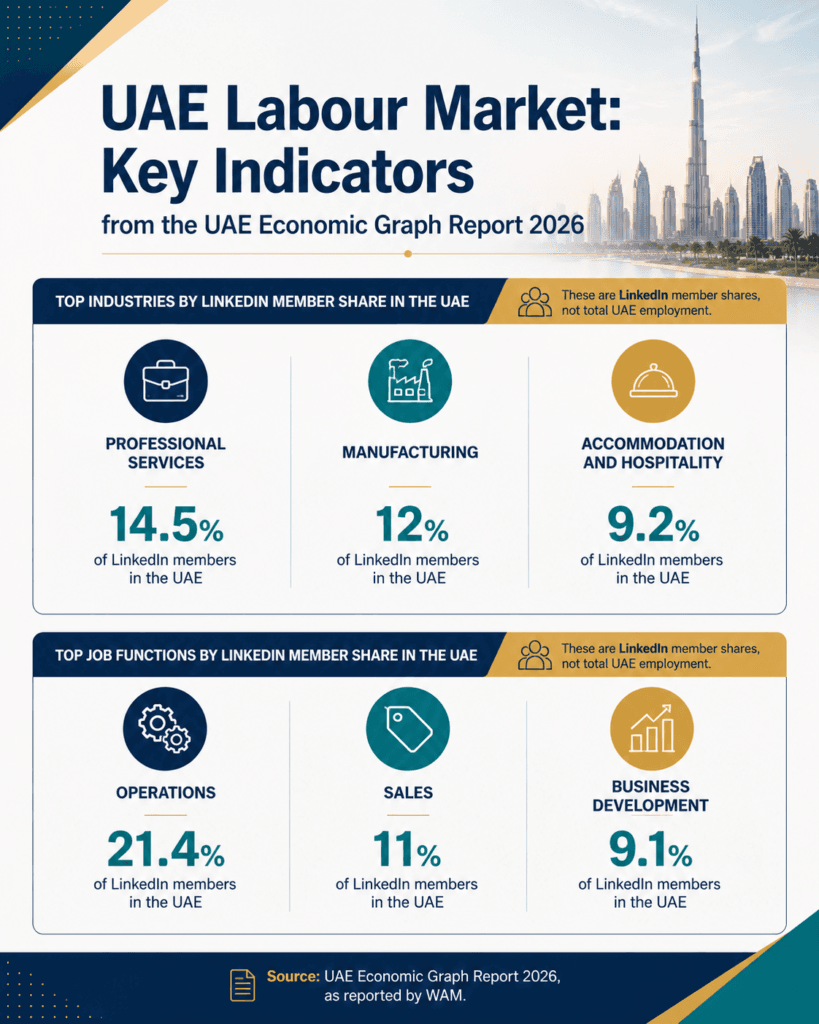
Professional services represented the largest share of LinkedIn members in the UAE, at 14.5%, followed by manufacturing at 12% and accommodation and hospitality at 9.2%. Operations accounted for the largest share by job function, at 21.4%, followed by sales at 11% and business development at 9.1%.
These figures point to an important conclusion: the UAE continues to attract and employ international talent, but the opportunity is increasingly concentrated in sectors and roles connected to economic growth, technology, regulation, infrastructure and business operations.
Skills are becoming more important
One of the clearest changes in the UAE employment market is the growing importance of skills that can be demonstrated in practice.
The UAE Economic Graph Report ranked the country first globally in fintech skills and second in attracting artificial-intelligence talent relative to population size. It also ranked the UAE tenth in business skills and eleventh in personal and behavioural skills.
For candidates, this means that qualifications remain valuable, but qualifications alone may not be enough. Employers are likely to ask a more practical question: what can the candidate deliver in the role?
A strong application should therefore show:
- The candidate’s technical and industry-specific skills.
- Evidence of measurable results.
- Familiarity with relevant systems and digital tools.
- The ability to work across business, technology, legal and operational teams.
- Knowledge of UAE regulations relevant to the position.
- Communication, problem-solving and stakeholder-management ability.
For example, an internal auditor should not rely only on a list of audit responsibilities. A stronger profile could explain how the candidate identified control weaknesses, reduced recurring findings, improved audit-cycle time, strengthened regulatory reporting or supported remediation by management.
Artificial intelligence is changing recruitment

Artificial intelligence is influencing both the nature of work and the way employers identify candidates. Although AI adoption differs by sector and employer, candidates should expect greater use of digital recruitment systems, structured screening and skills-based evaluation.
The UAE’s strong position in fintech and AI talent suggests that digital capability will become increasingly relevant even outside traditional technology roles.
This does not mean that every professional must become a software engineer. It does mean that candidates should understand how technology affects their own occupation.
For finance, audit and compliance professionals, relevant capabilities may include:
- Data analysis for risk-based audit planning.
- Continuous monitoring and exception reporting.
- Familiarity with governance, risk and compliance platforms.
- Technology-risk and IT-control assessment.
- Cybersecurity and data-governance awareness.
- Understanding of AI-related risks, controls and accountability.
- Use of automation to improve testing, documentation and reporting.
The strategic shift is from claiming that one is “familiar with technology” to demonstrating how technology has improved the quality, speed or reliability of one’s work.
Emiratisation remains a major labour-market factor
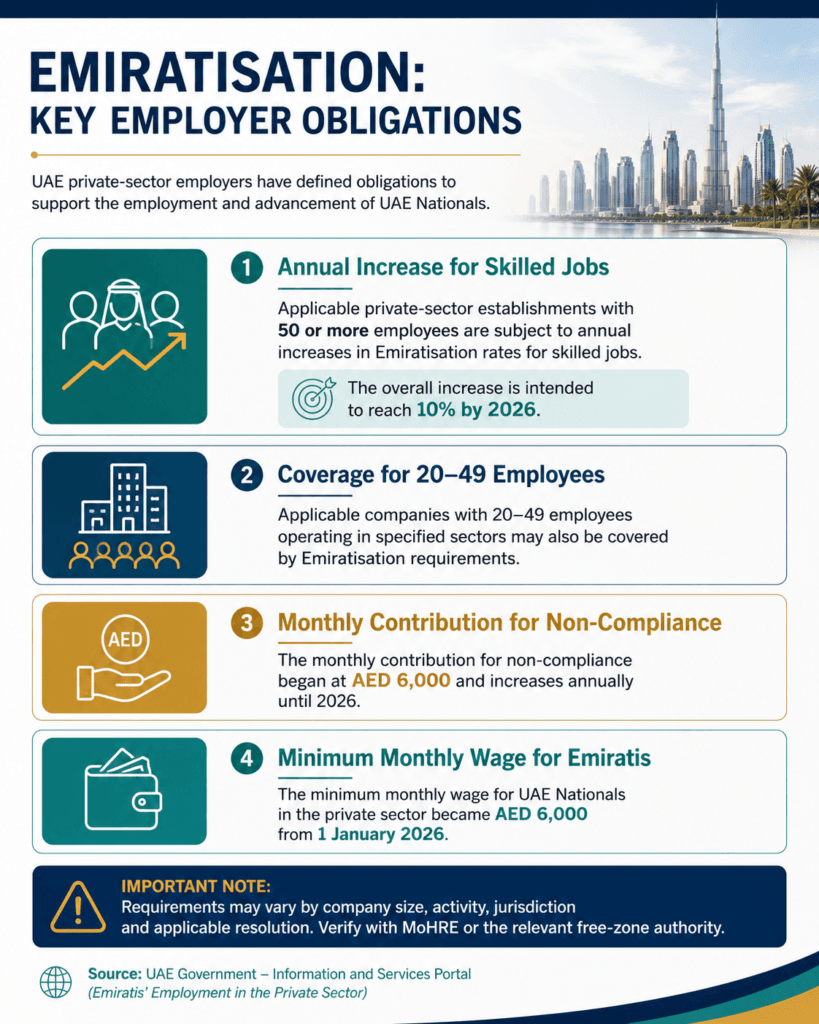
Emiratisation continues to shape recruitment in the UAE private sector. The official UAE Government platform states that private-sector establishments with 50 or more employees are subject to annual increases in Emiratisation rates for skilled jobs, with the overall increase intended to reach 10% by 2026.
The same official guidance states that non-compliant companies have been required to pay a monthly contribution for each Emirati not employed in accordance with the applicable target. The contribution began at AED 6,000 and increases by AED 1,000 annually until 2026.
The rules also apply to certain private companies with between 20 and 49 employees operating in specified sectors. The official list includes information and communications, financial and insurance activities, real estate, professional services, healthcare, education, construction, manufacturing, transport, wholesale and retail, and hospitality.u
From 1 January 2026, the Ministry of Human Resources and Emiratisation set the minimum monthly wage for Emiratis working in the private sector at AED 6,000, according to the UAE Government platform. The platform also describes employer obligations concerning work permits, employment contracts, salary payments, pension registration and genuine workplace participation.
What Emiratisation does not mean
Emiratisation should not be presented as a general prohibition on hiring expatriates. The rules create obligations for covered employers to meet specified Emiratisation targets and to avoid fraudulent practices. They do not eliminate the wider private-sector demand for international expertise.
For expatriate candidates, the practical lesson is to compete on clear, role-specific value. Candidates should be able to demonstrate specialist knowledge, sector experience, regulatory competence, language skills, client management or technical capability that directly matches the vacancy.
For employers, compliance should not be treated as a paper exercise. The official guidance warns against fake Emiratisation and misleading vacancies and requires employers to provide suitable work, tools, training and employment conditions.
The strongest opportunities are sector-specific
The UAE’s hiring performance is being supported by several sectors, but the available evidence does not justify claiming that every sector is expanding at the same rate.
Based on the UAE Economic Graph Report 2026, the sectors showing notable strength include:
- Real estate.
- Education.
- Construction.
- Healthcare.
- Administrative and support services.
- Transport and logistics.
- Professional services.
- Manufacturing.
- Technology and fintech-related activities.
The report also highlights the UAE’s continued ability to attract international talent and its growing digital-economy capabilities.
For professionals in banking, audit and compliance, the most relevant opportunities are likely to be connected to regulated financial services, fintech, risk management, AML and financial crime prevention, internal controls, governance, technology risk and regulatory reporting. However, candidates should verify each vacancy independently rather than assuming that a sector-wide trend guarantees a particular job offer.


What has changed for job seekers
The traditional UAE job-search approach often relied on submitting a standard CV to a large number of vacancies. That approach is now less reliable in a market where employers can receive a high volume of applications and use digital systems to filter candidates.
A more effective strategy should include the following.
1. Choose a clear professional position
A CV that presents a candidate as an accountant, auditor, compliance officer, analyst, administrator and operations professional at the same time may appear unfocused.
Candidates should select a primary target, such as:
- Internal audit and risk.
- AML and financial crime compliance.
- Regulatory compliance.
- IT audit and technology risk.
- Financial reporting and controllership.
- Governance, risk and compliance systems.
- Data analytics for finance and audit.
A clear position makes it easier for recruiters to understand the candidate’s value.
2. Tailor the CV to each vacancy
A tailored CV should reflect the language of the job description without copying it artificially. It should place the most relevant experience near the top and use achievement-based evidence.
Instead of writing:
Responsible for internal audit assignments and reporting.
A stronger statement would be:
Executed risk-based operational and compliance audits, tracked management action plans and reported control deficiencies to senior stakeholders.
The statement should be amended again when applying for a banking, fintech, manufacturing or public-sector role so that the most relevant sector experience is visible.
3. Demonstrate digital capability
Candidates should identify the technologies used in their profession and develop practical evidence of competence. For an audit or compliance professional, this could include a dashboard, sample risk assessment, data-testing exercise, control library or documented process-automation example.
The objective is not to list tools for keyword purposes. The objective is to show how technology supports better decisions and stronger controls.
4. Build relationships responsibly
Professional networking remains important, but it should not consist only of sending mass messages asking for a job. Candidates can build credibility by:
- Sharing practical industry observations.
- Commenting constructively on professional discussions.
- Attending relevant industry events.
- Contacting recruiters with a concise, role-specific introduction.
- Requesting informational conversations rather than immediate referrals.
- Maintaining relationships after an application is submitted.
For audit and compliance professionals, useful networking communities may include internal audit, risk, AML, fintech, banking, accounting and governance groups.
5. Verify every job offer
Job seekers should be cautious of recruitment scams, particularly offers that demand payment for registration, interviews, visa processing, employment or “guaranteed placement”.
The UAE Government’s labour framework places important obligations on employers, while official government guidance should be used to verify work-permit and employment procedures. Candidates should not rely solely on an email, WhatsApp message or an unofficial PDF.
MoHRE’s official channels should be treated as the primary reference for matters within its jurisdiction. Candidates should also verify whether a recruiter is properly licensed and should report suspected fraud to the relevant authorities.
Implications for audit and compliance professionals
The changing market presents both opportunity and risk for professionals in internal audit and compliance.
The opportunity comes from the UAE’s expanding financial, digital and regulated-business ecosystem. As businesses grow and regulation becomes more important, employers need people who can translate requirements into working controls, monitor implementation and communicate risk clearly.
The risk is that a general audit profile may no longer stand out. Candidates who perform only routine testing without showing knowledge of technology, data, regulatory change or business risk may face stronger competition from specialists.
A competitive profile for the UAE market could combine:
- CIA, CISA, ACCA, CA, CPA, CAMS or other relevant qualifications.
- UAE regulatory and compliance knowledge.
- AML, sanctions, KYC and financial-crime experience where relevant.
- IT general controls and application-controls knowledge.
- Data analytics and continuous-auditing capability.
- Experience with issue remediation and root-cause analysis.
- Strong written reporting and stakeholder communication.
- Familiarity with fintech, digital banking or virtual-asset risks where applicable.
The correct combination will depend on the target employer and role. Candidates should avoid collecting certifications without developing practical experience.
An opinion for job seekers and employers
The UAE job market is not closing its doors to talent. It is becoming more selective about the type of talent it rewards.
For job seekers, the market now favours clarity over volume, evidence over claims and specialised capability over a broad but indistinct profile. The most useful response is not panic-applying to every vacancy. It is building a focused professional proposition and applying it to employers whose needs genuinely match that proposition.
For employers, the challenge is to avoid confusing low-cost hiring with effective hiring. Emiratisation compliance, digital transformation and operational growth all require genuine workforce planning. A rushed recruitment process may fill a vacancy, but it will not necessarily produce capability, retention or compliance.
The UAE’s employment outlook therefore contains two realities at the same time: competition remains intense in some categories, while important opportunities continue to emerge in growth and specialist sectors. The candidates and employers most likely to succeed will be those who treat the labour market as a skills-and-value market rather than simply a CV market.